
Sunday, September 27, Tishrei 9, Erev Yom Kippur.
Genesis (Bereshit) 28:10-17 TLV
Parashat Vayetze
Jacob’s Ladder From Heaven
10 Then Jacob left Beer-sheba and went toward Haran. 11 He happened upon a certain place and spent the night there, for the sun had set. So he took one of the stones from the place and put it by his head and lay down in that place. 12 He dreamed: All of a sudden, there was a stairway set up on the earth and its top reaching to the heavens—and behold, angels of God going up and down on it! 13 Surprisingly, Adonai was standing on top of it[a] and He said, “I am Adonai, the God of your father Abraham and the God of Isaac. The land on which you lie, I will give it to you and to your seed. 14 Your seed will be as the dust of the land, and you will burst forth to the west and to the east and to the north and to the south. And in you all the families of the earth will be blessed—and in your seed. 15 Behold, I am with you, and I will watch over you wherever you go, and I will bring you back to this land, for I will not forsake you until I have done what I promised you.”
16 Jacob woke up from his sleep and said, “Undoubtedly, Adonai is in this place—and I was unaware.” 17 So he was afraid and said, “How fearsome this place is! This is none other than the House of God—this must be the gate of heaven!”
Footnotes: Genesis 28:13 Or, above him or next to him.
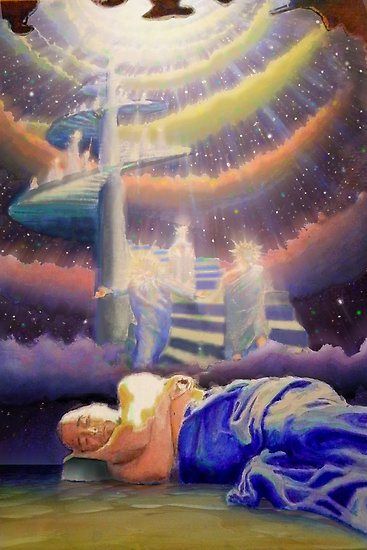
By Rabbi Simon Jacobson’s update newsletter
| TO BE LIKE ANGELS |
| Tonight we will begin a 25-hour fast of Yom Kippur. We don’t do this in order to afflict ourselves, which is the purpose of the fast of Tisha B’Av when we mourn the destruction of the Temple—indeed Yom Kippur is not a day of mourning but a day of joy. We fast on Yom Kippur because on this day we want to transcend our physical limitations and be like angels, and food and other physical concerns distract us from our spiritual selves. Some people may complain that the hunger distracts them from concentrating on the prayers and rituals of the day. But this is precisely the Yom Kippur challenge—not to be overly focused on the physical. Use the opportunity of not eating and not drinking to allow yourself to experience the food and drink that comes from deep within. Fasting will then become a very freeing experience. Yom Kippur is one day in the year when you can access the deepest part of your soul. But this is only possible if you create the space for it. Your soul—every soul—has a still, soft voice that emits a unique hum. This sound can only be heard if you lower the noise in your life that usually drowns out your inner voice. On Yom Kippur, when the “source” is nearest to the “spark” of your soul, you want to remove as many material distractions as you can, so that your soul can sing freely and your “spark” can dance. When you experience Yom Kippur this way—which does take effort, and that’s why you need to prepare for it—then it will be for you not a day when you feel hungry, but a day when you feel angelic. The same holds true for the other prohibitions of Yom Kippur—against bathing, anointing, marital relations, wearing leather, etc.—all of which are meant to detach us as much as possible from the physical realm so that we can be free to experienced the spiritual one. Instead of indulging in physical pleasures, we spend the day in the cocoon of a synagogue where we are cut off from the outside world. We spend the day in prayer—our whole intention being to transcend the physical world, our material home, and to travel inward toward our purest spiritual selves—toward our true home in G-d. |
| BREAKING THE TIES THAT BIND |
| Before darkness falls, marking the official beginning of the 10th day of Tishrei which is Yom Kippur, in every synagogue in the world a haunting melody is sang—Kol Nidrei. Kol Nidrei means “All Vows” and its classic text, repeated three times, each time louder, is a renunciation of all oaths and vows. It seems strange to begin the holiest day of the year—the day which we spend asking G-d to forgive us for all transgressions—by breaking former promises. But Kol Nidrei is not that. Kol Nidrei is the process through which we enter the holiest day of the year. A neder is not just the vow/promise that you vocalize to another person, it is a word that denotes all commitments, attachments, and ties that bind you. By renouncing “all vows” you are declaring your commitment to break the bonds that keep you from traveling on the journey within, that keep you from opening yourself to the Yom Kippur experience. Obviously, this does not mean forsaking healthy commitments and responsibilities—it means forsaking those attachments that limit you, that entangle and entrap you. That is the essential focus of Kol Nidrei. It is a perfect prayer to begin Yom Kippur with because unless you free yourself from such traps you cannot travel inward; with a ball and chain attached to you, you are not going to be able to get anywhere. Kol Nidrei is repeated three times to relate to vows in speech, vows in deed, and vows in thought: All vows and things we have made forbidden on ourselves… we regret having made them, may they all be permitted, forgiven, eradicated, and nullified, and may they not be valid or exist any longer. Our vows shall no longer be vows, and our prohibitions shall no longer be prohibited, and our oaths are no longer oaths. |
| Monday, September 28, Tishrei 10, Yom Kippur |
| THE DAY OF ONENESS |
| The preparation work in advance of Yom Kippur is a journey inward which culminates in the fifth and final prayer of the Yom Kippur service—Neilah (the “Locking of the Gates”). Every day we have three prayers—Maariv (the evening prayer),Shacharit (the morning prayer), Mincha (the afternoon prayer). On Shabbat and every other Jewish holiday we have a fourth—Musaf (the additional prayer). But only on Yom Kippur is there a fifth—Neilah. This is because Neilah corresponds to the fifth and highest dimension of the soul—the Holy of Holies of the soul—which we access only on this one day at this one time. The five dimensions of the soul (from lowest to highest) are: 5. Yechidah | “Oneness” | Essence 4. Chayah | “Life” | Transcendental life 3. Neshamah | “Soul” | Intellectual life 2. Ruach | “Breath” | Emotional life 1. Nefesh | “Spirit” | Biological life All days of the year we’re able to access the three dimensions of our soul; on Shabbat we access the fourth, chayah, but only on Yom Kippur can we access the fifth, yechidah—oneness with G-d. This is because during Neilah, before the gates are locked, everything is open and we are able to reach even yechidah which is the most intimate, vulnerable, tender, gentle part of the soul of the human being, unshielded by the defenses of the other levels. We reach it at the precise moment when Neilah is said, and when at its conclusion we declare: Shema Israel… “Hear O Israel, G-d is our G-d, G-d is One.” The Shaloh, the great medieval 16th century sage writes that “there is no higher experience for the Jew—as when he acknowledges the oneness of G-d and his readiness to give his entire life to G-d.” This is the moment when the spark and the flame come closest all year round. This is the most powerful moment of the year. This is the moment that you are the closest that you can come to the essence of everything, to G-d. |
Please click excellent spiritual pondering life on Yom Kippur: How to get the Most Out of Yom Kippur.
 Jesus Christ is New Paschal Lamb of God
You must be logged in to post a comment.