Shabbat Shalom in Mashiyach’s Name!
We all read Torah Parashah 46: The Hebrew word: ekev means because, if only. Eikev, Ekev, Ekeb, Aikev, or Eqeb (עֵקֶב — Hebrew for “if [you follow],” Please click H6118 (noun) comes from H6117 (verb)
This basic Hebrew word: ekev in Hebrew’s Strong Number we all learn:
H6118
עקב
‛êqeb
BDB Definition:
1) consequence (noun masculine)
1a) consequence
1b) consequence, gain, reward
1c) end
2) as a consequence, because, consequently (adverb)
3) as a consequence of, that, because (conjunction)
Part of Speech: see above in Definition
A Related Word by BDB/Strong’s Number: from H6117 in the sense of 6119

H6117
עקב
‛âqab
BDB Definition:
1) to supplant, circumvent, take by the heel, follow at the heel, assail insidiously, overreach
1a) (Qal) to supplant, overreach, attack at the heel
1b) (Piel) to hold back
Part of Speech: verb
A Related Word by BDB/Strong’s Number: a primitive root

The Messianic Bible:
Eikev: The Heel of Messiah (Mashiyach). The word eikev comes from the verb akav, which means to take by the heel. Similarly, the Hebrew noun akev means heel, as in the heel of a foot. All of these words share the root letters עָקַב ayin-qoph-bet.
Ancient Jewish sages interpreted this dual meaning of ayin-kof-vet to refer to the generation of the “heels of Mashiach (Messiah).”
The last generation of the Exile is called Ikvata d’Meshichah or the Heels of Messiah, since that generation is expected to hear the footsteps of the Messiah. The word akev is first used in Genesis in an important prophecy: the seed of Chava (Eve) will eventually crush the head of the serpent.
“And I will put enmity between you [the serpent] and the woman, and between your offspring and hers; He will crush your head, and you will strike His heel [akev].” (Genesis 3:15)
This is the first Messianic prophecy in the Bible. From it we understand that the enemy would attempt to strike at the heel of the Messiah; instead however, our Messiah would crush the enemy’s head and destroy the works of the devil.
“The one who does what is sinful is of the devil, because the devil has been sinning from the beginning. The reason the Son of God appeared was to destroy the devil’s work.” (1 John 3:8)
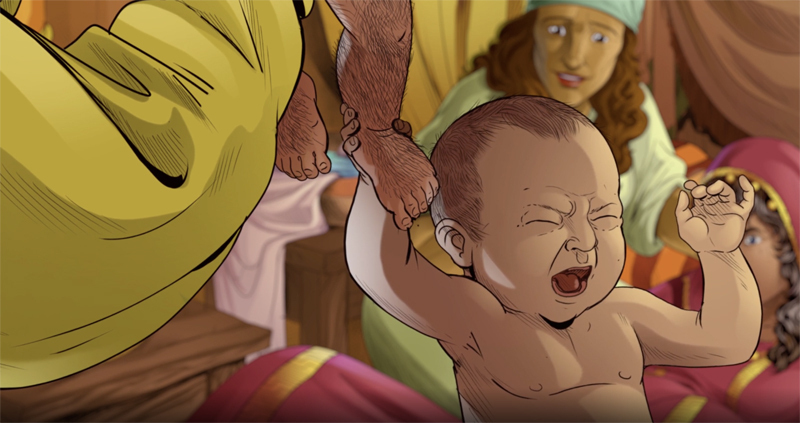
Isaac and Rebekah’s twin sons Esau and Jacob on Genesis 25:24-25 TLV:
24 When her time came to give birth, indeed there were twins in her womb. 25 Now the first came out reddish, all of him was like a fur coat, and they named him Esau. 26 Afterward his brother came out with his hand holding onto Esau’s heel—so he was named Jacob. Isaac was 60 years old when he fathered them.
Genesis 25 TLV Parashat Toledot
Esau and Jacob
19 Now these are the genealogies of Isaac, Abraham’s son. Abraham fathered Isaac. 20 Isaac was 40 years old when he took for himself Rebekah, the daughter of Bethuel the Aramean from Paddan-aram, the sister of Laban the Aramean, to be his wife. 21 Isaac prayed to Adonai on behalf of his wife because she was barren. Adonai answered his plea and his wife Rebekah became pregnant.
22 But the children struggled with one another inside her, and she said, “If it’s like this, why is this happening to me?” So she went to inquire of Adonai. 23 Adonai said to her:
“Two nations are in your womb,
and two peoples from your body
will be separated.
One people will be stronger
than the other people,
but the older will serve the younger.”
24 When her time came to give birth, indeed there were twins in her womb. 25 Now the first came out reddish, all of him was like a fur coat, and they named him Esau. 26 Afterward his brother came out with his hand holding onto Esau’s heel—so he was named Jacob. Isaac was 60 years old when he fathered them.
27 When the boys grew up, Esau became a man knowledgeable in hunting, an outdoorsman, while Jacob was a mild man, remaining in tents. 28 Now Isaac loved Esau because he had a taste for wild game, but Rebekah loved Jacob.
29 Now Jacob cooked a stew. When Esau came in from the field, he was exhausted, 30 so Esau said to Jacob, “Please feed me some of this really red stuff, because I’m exhausted”—that is why he is called Edom.
31 So Jacob said, “Sell your birthright to me today.”
32 Esau said, “Look, I’m about to die. Of whatever use is this to me—a birthright?”
33 Jacob said, “Make a pledge to me now.”
So he made a pledge to him, and sold his birthright to Jacob. [a]34 Then Jacob gave Esau bread and lentil stew, and he ate and drank, then got up and left. So Esau despised his birthright.
Footnotes
- Genesis 25:34 cf. Heb. 12:16.

Again, we all read Torah Parashah 46# ekev on James 5:7-11 TLV first who was James? James the Just, the (half-)brother of Yeshua haMashiyach of Nazareth on Brit Chadasha (New Testament/Renewed Covenant).
James 5:7-11 TLV Be Patient for His Coming
7 So be patient, brothers and sisters, until the coming of the Lord. See how the farmer waits for the precious fruit of the earth, being patient for it until it receives the early and late rain. [a] 8 You also be patient. Strengthen your hearts because the coming of the Lord is near. 9 Do not grumble against one another, brothers and sisters, so that you may not be judged. Behold, the judge is standing at the doors. 10 As an example of suffering and patience, brothers and sisters, take the prophets who spoke in the name of the Lord.
11 Behold, we consider blessed those who showed endurance. You have heard of the endurance of Job,[b] and you have seen the outcome of Adonai—that Adonai is full of compassion and mercy.[c]
Footnotes
- James 5:8 cf. Deut. 11:14; Jer. 5:24; Hos. 6:3; Joel 2:23.
- James 5:11 cf. Job 1:21-22.
- James 5:11 cf. Ex. 34:6; Ps. 103:8.
James, Jacob: Ya’akov
(YA-a-kohv) n. Jacob. The son of Isaac, grandson of Abraham, and the father of the twelve patriarchs of the tribes of Israel. Ya’akov means “heel holder” or “supplanter”; later he was renamed “Israel” (“God will fight”) by Adonai (Gen. 32:28).
 Jesus Christ is New Paschal Lamb of God
You must be logged in to post a comment.