Exodus 12:5-7
5Your lamb must be an unblemished year-old male, and you may take it from the sheep or the goats. 6You must keep it until the fourteenth day of the month, when the whole assembly of the congregation of Israel will slaughter the animals at *twilight. 7They are to take some of the blood and put it on the sides and tops of the doorframes of the houses where they eat the lambs.
The Lamb Selection Day means …And you shall keep it (lamb year-old male perfect without a blemish) for inspection is the key on 10th of Nisan before Pesach (Passover) to slaughter lamb in the afternoon (read more about between two evenings).
Exodus 12:6 …inspection…👇
6And you shall keep it for inspection until the fourteenth day of this month, and the entire congregation of the community of Israel shall slaughter it in the afternoon.

This above photo is excellent visualization with fully comprehensive two columns of day and night.
The above photo of night: *twilight means Hebrew between the two evenings
Famous Jewish commentator Alfred Edersheim agrees with this, writing:
The period designated as ‘between the two evenings’ when the Paschal lamb was to be slain, was past. There can be no question that, in the time of Christ, it was understood to refer to the interval between the commencement of the sun’s decline and what was reck- oned as the hour of his final disappearance (about 6 p.m.).339
The Jewish Encyclopedia verifies this same time frame:
The time “between the two evenings” (“ben ha-’arbayim”) was construed to mean “after noon and until nightfall”340
The chart below illustrates the sun ascending (from 6 am to noon) and descending (from noon to 6 pm, around sunset). If you picture the sun in relation to the vertical line and the horizontal line in the chart below, this line is “even” with the horizon at noon, and is again “even” with the horizon at sunset. Thus, between the even-ings is the time between noon and sunset, as both Edersheim and The Jewish Encyclopedia noted.
339 Edersheim, Life and Times, p. 490.
340 The Jewish Encyclopedia, vol. 9, p. 553, s.v. “Passover/Paschal Lamb.”
This passage is interesting because it does not quote the Hebrew “between the eve- nings” but rather the Greek Septuagint, which reads “toward evening”:
LXE Exodus 12:6 And it shall be kept by you till the fourteenth of this month, and all the multitude of the congregation of the children of Israel shall kill it toward evening.
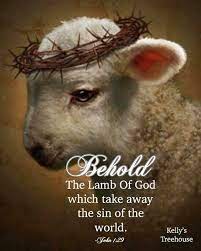
1 Peter 1:19 but with precious blood, as of a lamb unblemished and spotless, the blood of Christ.
Yeshua fulfilled the regulations (rules/qualifications) the Precious Blood of the Pesach Lamb Substitutor:
- The Passover lamb was to be chosen and set apart on the 10th day of the first month of Nisan/Abib.
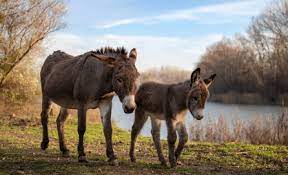
a. Fulfillment: On the 10th day of Nisan, Yeshua rode into Jerusalem on the foal of a donkey and was hailed as the King of the Jews.
b. Palm Sunday In Matthew 21:1–11, Mark 11:1–11, Luke 19:28–44, and John 12:12–19, Palm Sunday, also called Passion Sunday, in the Catholic Christian tradition, the Sixth Sunday of Lent and Holy Week before Easter (Resurrection of Jesus) commemorates Jesus Christ and his triumphal entry into Jerusalem. It is associated in many churches with the blessing and procession of palms (leaves of the date palm) or twigs from locally available trees).

- The lamb was to be inspected for four days until the 14th day of the month for any spot or blemish that might disqualify it as the sacrificial lamb.
a. Fulfillment: Yeshua openly taught in the Holy Temple and synagogues until the 14th day of the month and no fault could be found in Him. - At the appointed time, the Passover lambs were slain by the whole congregation of Israel.
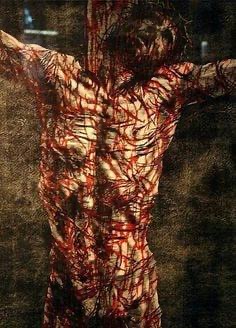
a. Fulfillment: Yeshua Himself Blood of Pesach Lamb of God Substitutor, was delivered and publicly killed on a Roman execution stake as the Passover lambs were being slaughtered. - Under the Roman law, there were no maximum limits numbers flogging elaborates Flagellation (Latin flagellum, ‘whip’), flogging or whipping is the act of beating the human body (Yeshua/Jesus) below,photo like this:
Pilate had Yeshua scourged Josephus‘s details on Roman law:
‘…And when their leaders came into the house, Josephus drew them to the most private part of the house and shut the door, and then had them whipped till every one of their inward parts appeared naked. In the meantime the multitude stood around the house and supposed that he was having a long discourse with those that were gone in, about what they claimed of him. He then had the doors set open immediately, and sent the men out all bloody, which so terrified those that had before threatened him, that they threw away their arms and ran away.’ Josephus, Wars, Book 2, 21:5
Under Roman Law that time of Yeshua had scourged many lashes of no maximum limits:
No mercy! Scourging was an excessive brutal torture punishment and it was standard practice in history before a crucifixion. The whip, the flagellum, had several thongs, each one of which had pieces of bone or metal attached. It made a bloody pulp of a man’s body.
Under Romans Law, there was no maximum number of strokes: the whipping could go on as long as the soldier administering it wished. Men frequently collapsed and died as the result of a flogging. That’s why the Jewish historian Josephus described details what he saw through that occurred awful cruelty whipping.
Remember Paul (Rav Shaul) went through flogging of 39 lashes 5 times under Jewish Law:
2 Corinthians 11:24 Five times the Jews have given me ·their punishment of thirty-nine lashes with a whip [L forty minus one; C a shorthand phrase for the standard Jewish punishment; Deut. 25:1–3 allowed a maximum of forty lashes; the Jews gave thirty-nine to avoid breaking the law].
Under Jewish Law and Roman Law: 2 Corinthians 11:25 first read slowly:
Three times I (Paul/Shaul) have been scourged with rods, one time I was stoned, three times I have been shipwrecked, a day and a night I have been in the sea without a ship,
a. Paul scourged with rods 3 times by the Roman magistrates. Magistrates: in Greek, stratēgoi, the popular designation of the duoviri, the highest officials of the Roman colony of Philippi.
b. Paul was stoned 1 time by some Jews. (Acts 14:19)
c. Paul had shipwrecked 3 times and swan in the deep sea (Acts 27) Julius, a Roman centurion of Augustus’ band.
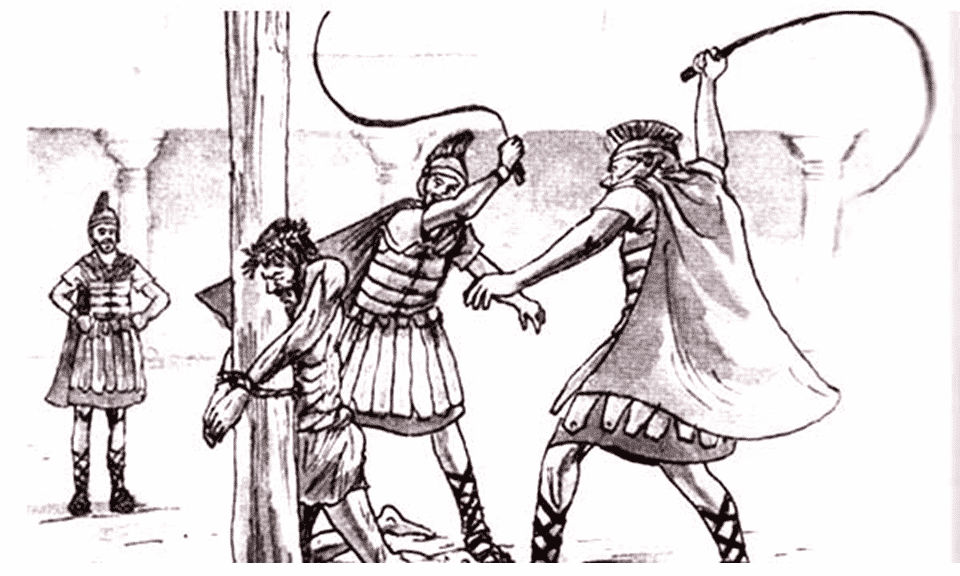
Matthew 27:26-31, Mark 15:16-20, Luke 23:20-22, John 19:1-5
The flagellation of Mashiyach/Messiah/Christ means Anointed One at column/post/pillar some says “The Column of the Flagellation”
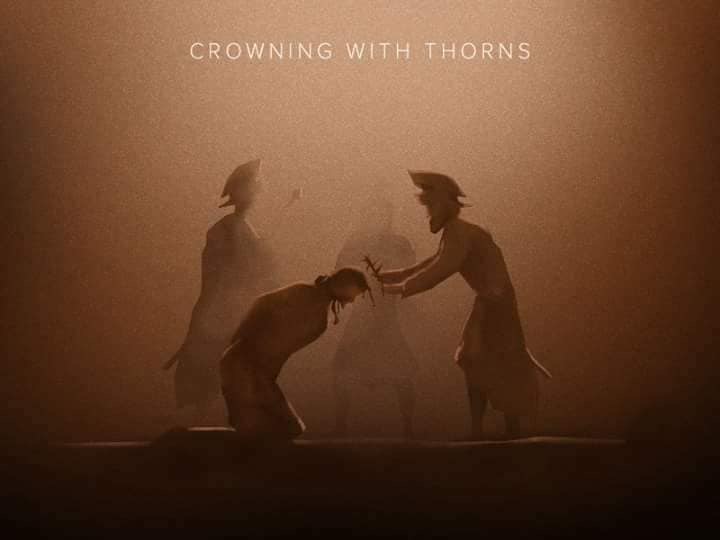
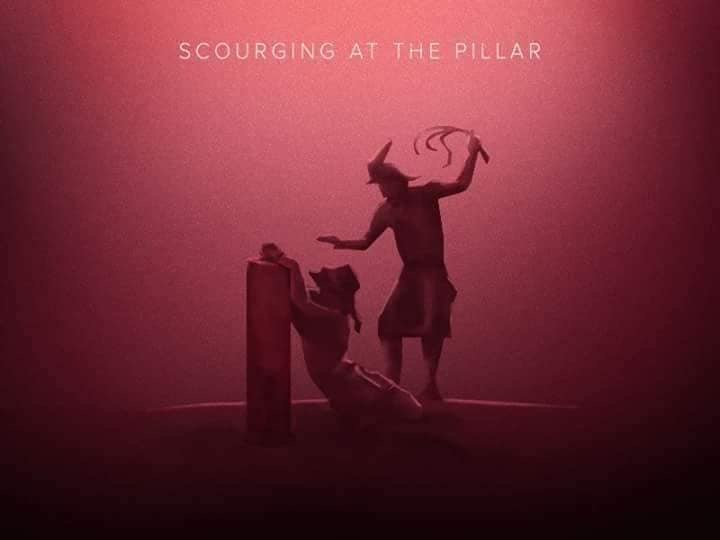
The Roman scourge, also called the “flagrum” or “flagellum” was a short whip made of two or three leather (ox-hide) thongs or ropes connected to a handle as in the sketch above. The leather thongs were knotted with a number of small pieces of metal, usually bronze or iron, attached at various intervals.
”Lamb Selection Day”: The lamb was to be examined/inspected for four (4) days. Same parallel that very day that Yeshua/Jesus rode into Jerusalem on the colt of a donkey was the day that Jewish people called “Lamb Selection Day” ON 10th day of the month of Nisan by pharisaical group examined and wanted to kill Yeshua Himself Blood of Pesach Lamb of God – the lambs that were going to be sacrificed in the Temple for Pesach (Passover) were brought into the Jerusalem City.
Exodus 12:3-5 tells us that at the first Passover in Egypt, God had commanded the Jewish people to take a lamb into each home and scrutinize each lamb to ensure that it was without blemish.
We all see the lamb was inspected for 4 days same parallel on King Yeshua rode donkey with foal into Jerusalem on the 10th of Nisan – on Lamb Selection Day!
Unfortunately, the disciples fail to see and comprehend that Yeshua and his divine instructions involve TaNaKH (Old Testament) foreshadowing fulfillment of Zechariah’s prophecy. He (Zachariah) foretold that God and His Divine Promise Revelation:
👉King would come into Jerusalem “humble and riding on a donkey, on a colt, the foal of a female donkey.”👈
Zechariah 9:9 NABRE Exult (Rejoice) greatly, O daughter Zion! Shout for joy, O daughter Jerusalem! Behold: your king is coming to you, a just savior is he, Humble, and riding on a donkey, on a colt, the foal of a donkey.
My recent blog clicks on Triumphal Entry – The King enters Jerusalem
 Jesus Christ is New Paschal Lamb of God
You must be logged in to post a comment.