USCCB April 25 Feast of Saint Mark, evangelist
First Reading: First Peter 5: 5b-14
Psalms: Psalms 89: 2-3, 6-7, 16-17
Alleluia: First Corinthians 1: 23a, 24b
Gospel: Mark 16: 15-20
The Feast of St. Mark is celebrated on April 25th. St. Mark is the patron saint of notaries, attorneys, lawyers, barristers, captives, prisoners, imprisoned people, glaziers, and stained glass workers.

Saint Mark represented as the winged lion because St. Mark the Evangelist and his description of John the Baptist’s voice “crying out in the wilderness” upon hearing the Word of God (Mark 1:3). His voice is said to have sounded like that of a roaring lion. This lion symbolism also appears in a vision of the Prophet Ezekiel where four winged creatures represent the four evangelists (Ezekiel 1:10)
In Revelations 4:7 we all read:
“And the first living creature resembled a lion, and the second living creature resembled a calf, and the third living creature had a face like a man, and the fourth living creature resembled a flying eagle.”
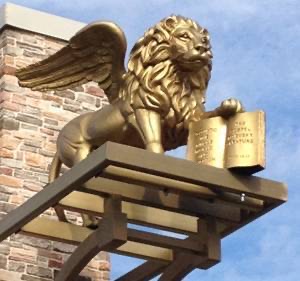
Interesting fact “the above logo photo” of St. Mark & his journey:
The Lion of Saint Mark is also the symbol of the city of Venice. Venetian tradition states that when St. Mark was traveling through Europe, he arrived at a lagoon in Venice, where an angel appeared to him and said “May Peace be with you, Mark, my evangelist. Here your body will rest.” The remains of St. Mark are interred in the Basilica of St. Mark which is located in the famous St. Mark Square (Piazza San Marco) of Venice.
Saint Mark Winged Lion Gospel Writer Evangelist Mosaic Angels Saint Peter’s Basilica Vatican Rome Italy. Mosaic right below Michaelangelo’s Dome
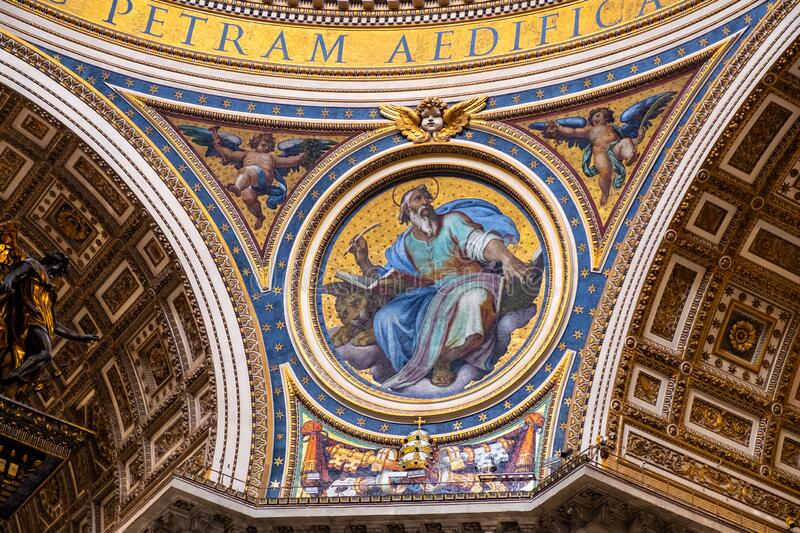

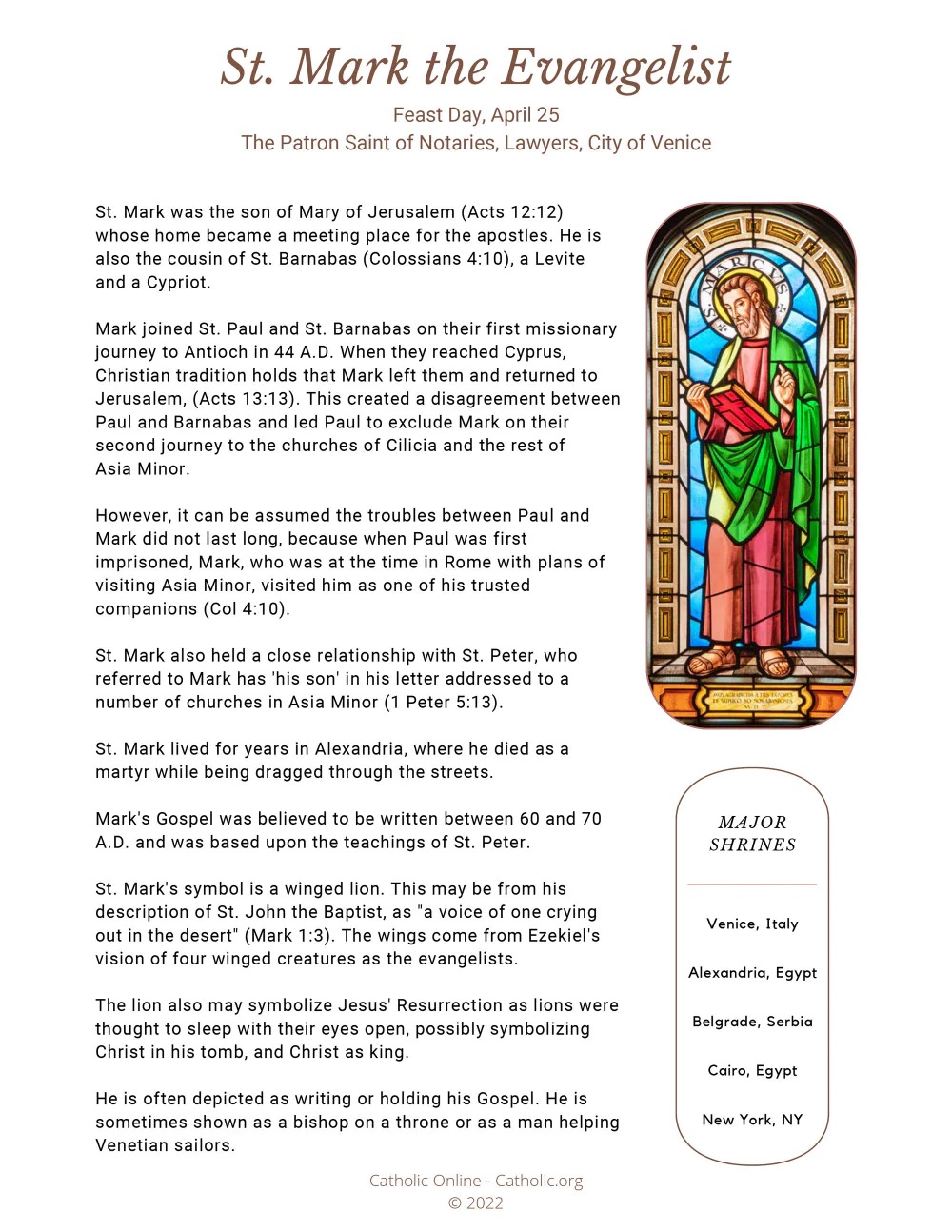
I enjoy reading Irish Jesuits and St Mark, Evangelist
St Mark, Evangelist (Feast)
A John Mark first appears in the Acts of the Apostles (Acts 12:12), after Peter was miraculously released from prison. When Peter realised that he was really free, he made his way to the house of Mary, who was the mother of John Mark, and whose house seems to have been a meeting place for Jerusalem Christians. At the end of the same chapter, we are told that Saul and Barnabas, who had earlier gone to Jerusalem on a relief mission to provide food for the Christians there, had returned to Antioch bringing John Mark with them. Soon after this, Barnabas and Paul were chosen by the community in Antioch to go on a missionary enterprise, known now as Paul’s First Missionary Journey. They sailed from the nearby port of Seleucia and went first to Salamis on the island of Cyprus. Along with them, they brought John Mark, a cousin of Barnabas. From Salamis they went on to Paphos at the other end of the island, where they converted the governor to Christianity.
From Paphos, the missionaries left Cyprus and went on to Perga, a city in Pamphylia, on the south coast of what is now Turkey. It was here we are told John Mark left Barnabas and Paul and returned to Jerusalem, although the reason is not given. Later, when Barnabas and Saul were setting out on their second missionary journey, Barnabas wanted to take John Mark with them. Paul, however, was not willing to take John Mark, now called Mark, because he had left them at Perga on their first mission. This caused a serious disagreement between Barnabas and Paul. Barnabas left Paul and, taking his cousin (John) Mark with him, went back to Cyprus. Paul then chose Silas as his missionary companion.
Relations seem to have improved subsequently because in Paul’s Letter to the Christians at Colosse, Paul writes: “Aristarchus, who is in prison with me, sends you greetings and so does Mark, the cousin of Barnabas.” In the Second Letter to Timothy, Paul writes: “Only Luke is with me. Get Mark and bring him with you, because he can help me in the work…” In the short Letter to Philemon, Mark is cited as one of the helpers of Paul. And at the end of the First Letter of Peter we read: “Your sister church in Babylon [a code word for Rome], also chosen by God, sends you greetings, and so does my son Mark.”
There is also a tradition that Mark was the founder of the Church in Alexandria, in northern Egypt.
The writing of the second gospel is also attributed to Mark, but it is not absolutely certain that it is the same person (the authorship of ancient texts is always tricky). The gospel was probably written in Rome before 60 AD, and there are certainly indications that John Mark was there at the time. It was written in Greek and directed to Gentile converts to Christianity. Tradition says that Mark was requested by the Christians of Rome to set down the teachings of Peter. This seems confirmed by the position which Peter has in this gospel. The gospel is thus understood as a record of the mission of Jesus as seen through the eyes of Peter. It is also the first gospel to be written, and both Matthew and Luke in their longer gospels certainly borrow extensively from Mark. Mark’s gospel is one of the most lively and readable accounts with more emphasis on the actions of Jesus, and where Jesus teaches more by what he does than what he says.
 Jesus Christ is New Paschal Lamb of God
You must be logged in to post a comment.