
National Interpreter Appreciation Day is celebrated on May 3 this year. It is always observed on the first Wednesday of May. There are about 6,500 languages in the world, and, naturally, no one person can learn them all. A person who can speak more than five languages is rare and is called a polyglot. Thus, interpreters are needed in government offices, hospitals, businesses, and any organization that will have to deal with people from different linguistic groups or when sign language is needed. Interpreters never have it easy. They have to keep up with the communicators and make sure they pass clear and concise information in real-time.
The United States Conference of Catholic Bishops (USCCB)
Reading 1 1 Cor 15:1-8
Responsorial Psalm Ps 19:2-3, 4-5
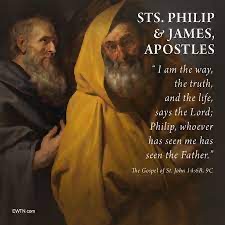
Alleluia Jn 14:6b, 9c
Gospel Jn 14:6-14
Why do Saints Philip and James the Less share a feast day?
It is believed that the reason Sts. Philip and James share a feast day is because their relics were brought to Rome together in early May of 560 A.D.. They were placed in a Basilica dedicated to them, located near the center of Rome. This Basilica has since been rededicated to the Twelve Holy Apostles.
I love reading from Irish Jesuits and Commentary on May 3, 2023:
We celebrate today the feast of two of the Twelve Apostles – James and Philip.
James is known as the ‘son of Alphaeus’ and, to be honest, we know practically nothing about him beyond his name and that he was chosen to be one of the inner circle of Jesus’ disciples – the Twelve. He is known as ‘James the Less’ and is not to be confused with James, one of the two sons of Zebedee, known as ‘James the Greater’. Nor is he to be confused with James, son of Clopas in the Acts of the Apostles, who was a “brother” (cousin) of Jesus, later ‘bishop’ of Jerusalem and the traditional author of the Letter of James.
Philip came from the same town as Peter and Andrew, Bethsaida in Galilee. In the first chapter of John’s gospel we see Jesus calling him directly, whereupon he went in search of Nathanael and told him about the “one about whom Moses wrote” (John 1:43-45). Philip comes across as someone who is rather innocent and naïve, and it takes him some time to acknowledge the full identity of Jesus.
The naivety of his character comes across in two incidents in the Gospel, one of which is described in the Gospel reading. The other took place when Jesus had crossed Lake Galilee in a boat with his disciples and was faced by a huge crowd of people waiting for him (John 6:1). The people were hungry in both body and spirit. Knowing how he was going to deal with the situation, Jesus teasingly asked the simple Philip where they could get bread to feed such a huge crowd. John comments, that Jesus:
…said this to test him, because he himself knew what he was going to do. (John 6:6)
Philip innocently replied,
Two hundred days’ wages worth of food would not be enough for each of them to have even a little. (John 6:7)
In other words, there was no way it could be done. But Philip would very soon find out how the problem would be solved, namely, when a small boy gave generously gave away his lunch of five loaves and two fish.
Because Philip’s name was Greek (Philippos, meaning ‘lover of horses’), we are told that one day two ‘Greeks’, probably converts to Judaism, approached him and his companion, Andrew (Andreos, also a Greek name, meaning ‘manly’), and said they wanted to “see Jesus”. Jesus is in Jerusalem and it is on the eve of his Passion. When told about this request, Jesus replied enigmatically with the image of the seed having to fall into the ground and die before it gave fruit. Clearly, it was a way of telling these men that ‘seeing’ Jesus was much more than seeing his exterior; they would also have to grasp the inner meaning of his sacrificial death as an essential part of his identity.

This morning I enjoyed research Saint Phillipos
The name “Phillipos” has been around for centuries and literally means “horse lover” or “friend of the horses”.
The name derives from the Latin Philippus in its turn resumed from the Greek Philippos. It is composed from “philein”, to love, and “hippos”, horse. Its meaning is therefore “lover of the horses or friend of the horses”.
 Jesus Christ is New Paschal Lamb of God
You must be logged in to post a comment.