CATECHISM OF THE CATHOLIC CHURCH
SECOND EDITION
The eremitic life
920 Without always professing the three evangelical counsels publicly, hermits “devote their life to the praise of God and salvation of the world through a stricter separation from the world, the silence of solitude and assiduous prayer and penance.”460
921 They manifest to everyone the interior aspect of the mystery of the Church, that is, personal intimacy with Christ. Hidden from the eyes of men, the life of the hermit is a silent preaching of the Lord, to whom he has surrendered his life simply because he is everything to him. Here is a particular call to find in the desert, in the thick of spiritual battle, the glory of the Crucified One.
460 CIC, can. 603 § 1.
Code of Canon Law
Can. 603 §1. In addition to institutes of consecrated life, the Church recognizes the eremitic or anchoritic life by which the Christian faithful devote their life to the praise of God and the salvation of the world through a stricter withdrawal from the world, the silence of solitude, and assiduous prayer and penance.
§2. A hermit is recognized by law as one dedicated to God in consecrated life if he or she publicly professes in the hands of the diocesan bishop the three evangelical counsels, confirmed by vow or other sacred bond, and observes a proper program of living under his direction.
Please click Code of Canon Law
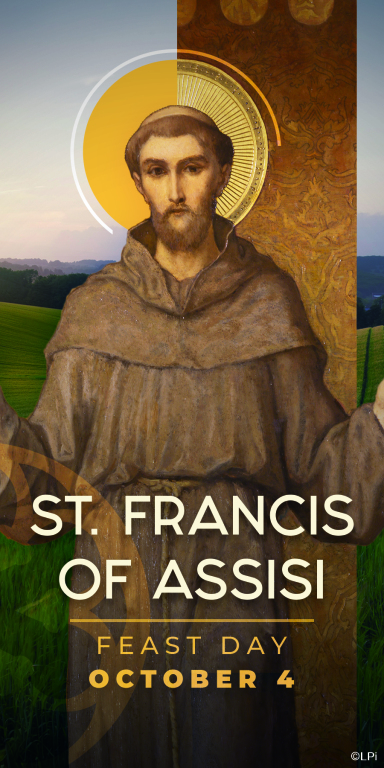
Please click St. Francis of Assisi “An Eremitic Life”
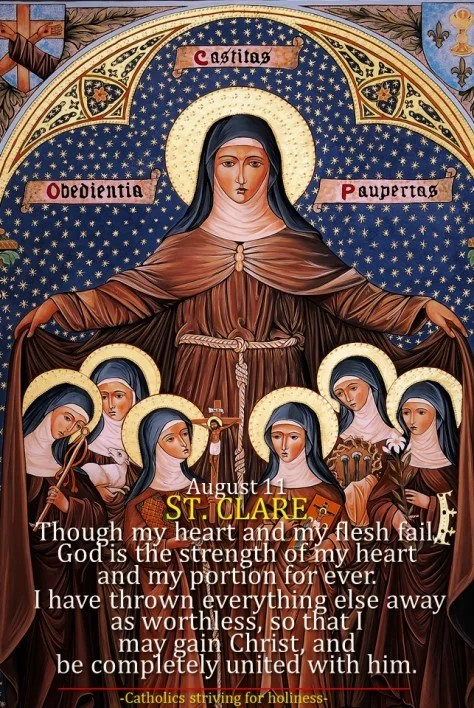
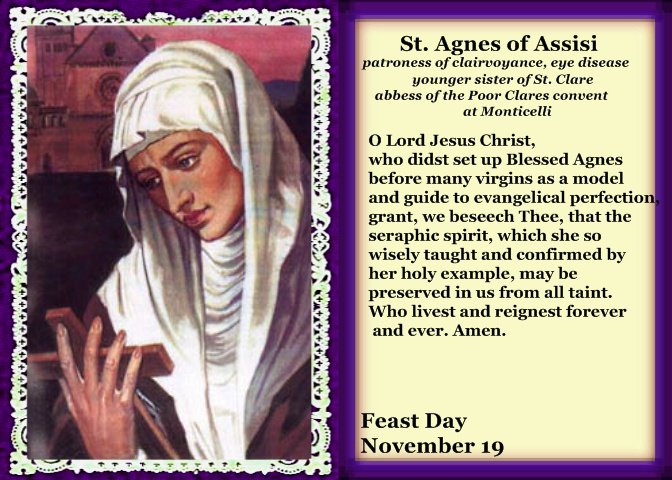
Saint Agnes of Assisi’s Story: Saint of the Feast Day for November 19
Agnes in Latin agnus means “holy pure lamb”. That’s why I see on John 1:29.
Agnus Dei is the Latin title under which the “Lamb of God” refers Jesus. The Sacred Scripture of the title “Lamb of God” in liturgy is based on John 1:29, in which St. John the Baptist, upon seeing Jesus, proclaims “Behold, the Lamb of God, who takes away the sin of the world!”
(c. 1197 – November 16, 1253)
Born Caterina Offreducia, Agnes was the younger sister of Saint Clare, and her first follower. When Caterina left home two weeks after Clare’s departure, their family attempted to bring her back by force. They tried to drag her out of the monastery, but her body suddenly became so heavy that several knights could not budge it. Her uncle Monaldo tried to strike her but was temporarily paralyzed. The knights then left Caterina and Clare in peace. Saint Francis himself gave Clare’s sister the name Agnes, because she was gentle like a young lamb.
Agnes matched her sister in devotion to prayer and in willingness to endure the strict penances that characterized the Poor Ladies’ lives at San Damiano. In 1221, a group of Benedictine nuns in Monticelli near Florence asked to become Poor Ladies. Saint Clare sent Agnes to become abbess of that monastery. Agnes soon wrote a rather sad letter about how much she missed Clare and the other nuns at San Damiano. After establishing other monasteries of Poor Ladies in northern Italy, Agnes was recalled to San Damiano in 1253, as Clare lay dying.
Three months later Agnes followed Clare in death, and was canonized in 1753. Agnes of Assisi (1197 or 1198 – 16 November 1253) was a younger sister of Clare of Assisi and one of the first abbesses of the Order of Poor Ladies (now the Poor Clares). Pope Benedict XIV canonized her as a saint in 1753. Please check on St. Agnes of Assisi
Update on January 23, 2024
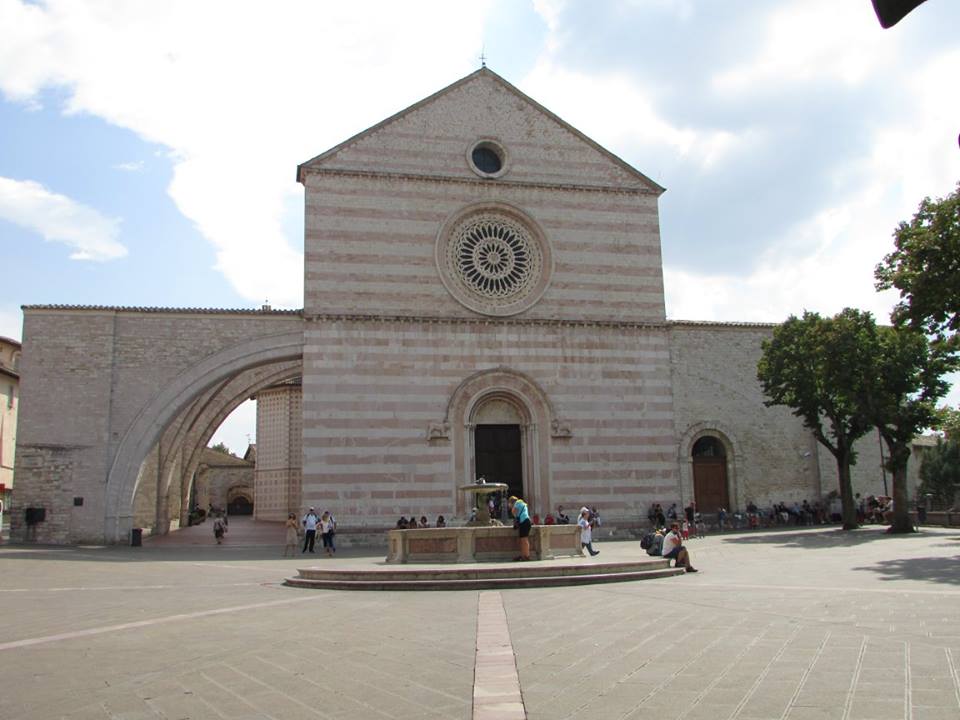
Agnes died three months after the death of Clare, on November 16, 1253, at the monastery of San Damiano of natural causes at the age of 56, Her mother, Hortulana, and a younger sister, Beatrice, had already died, and Agnes was buried near them in the Church of Santa Chiara in Assisi, Italy.
The Basilica of Saint Clare is a church in Assisi, central Italy. It is dedicated to and contains the remains of Clare of Assisi, a follower of Francis of Assisi and founder of the Order of Poor Ladies, known today as the Order of Saint Clare. Basilica of Saint Clare.
St Agnes of Assisi, Provincia di Perugia, Umbria, Italy Burial Site Photo:
Saint Quote
“I come, O Lord, unto Thy sanctuary to see the life and food of my soul. As I hope in Thee, O Lord, inspire me with that confidence which brings me to Thy holy mountain. Permit me, Divine Jesus, to come closer to Thee, that my whole soul may do homage to the greatness of Thy majesty; that my heart, with its tenderest affections, may acknowledge Thine infinite love; that my memory may dwell on the admirable mysteries here renewed every day, and that the sacrifice of my whole being may accompany Thine.”
~St. Agnes of Assisi
Prayer
Father of mercies,
St Agnes did not hesitate to suffer for love of you.
Grant that we too may be willing to share
whatever comes our way,
and always seek your will.
We make our prayer through Christ our Lord .
Amen.
 Jesus Christ is New Paschal Lamb of God
You must be logged in to post a comment.