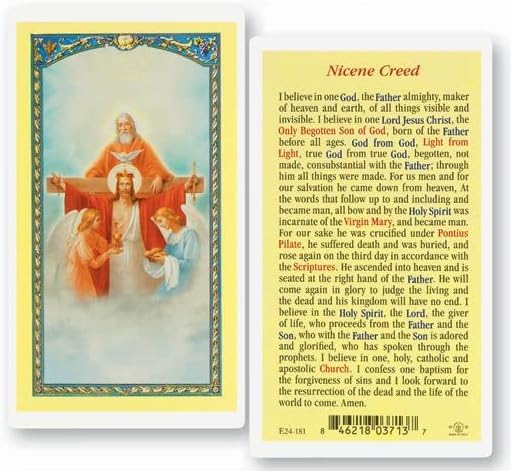
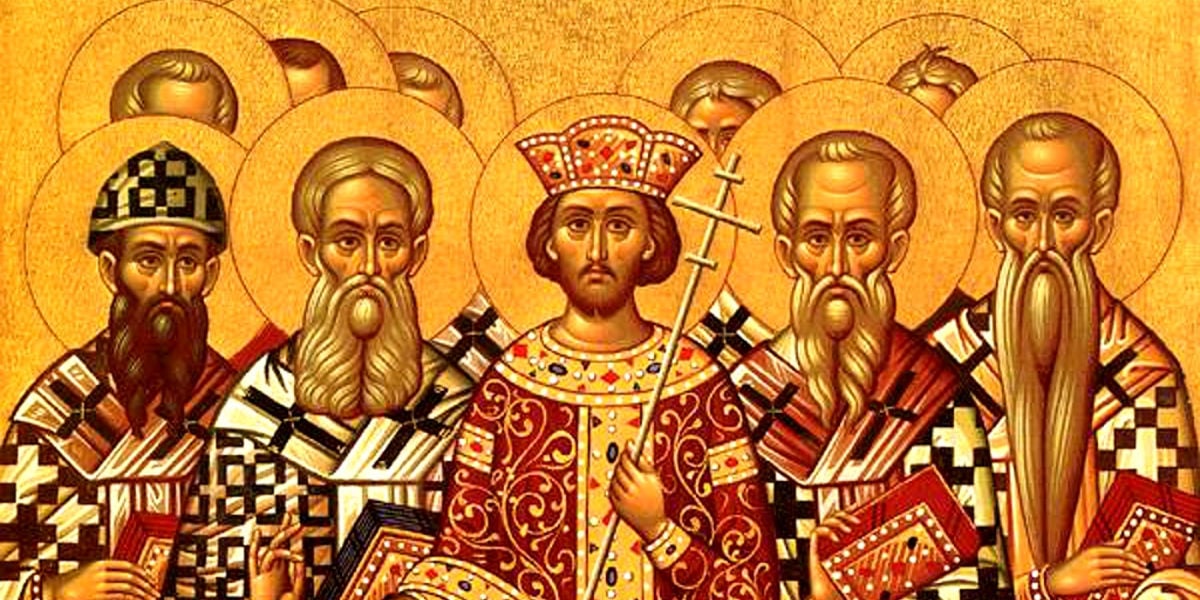
The Niceno-Constantinopolitan or Nicene Creed draws its great authority from the fact that it stems from the first two ecumenical Councils (in 325 and 381). It remains common to all the great Churches of both East and West to this day. – The Creed, CCC 195
Following this apostolic tradition, the Church confessed at the first ecumenical council at Nicaea (325) that the Son is “consubstantial” with the Father, that is, one only God with him.* The second ecumenical council, held at Constantinople in 381, kept this expression in its formulation of the Nicene Creed and confessed “the Only Begotten Son of God, born of the Father before all ages. God from God, Light from Light, true God from true God, begotten, not made, consubstantial with the Father.”* – II. The Revelation of God as Trinity, CCC 242
66 The English phrases “of one being” and “one in being” translate the Greek word homoousios, which was rendered in Latin by consubstantialis.
67 Niceno-Constantinopolitan Creed; cf. DS 150.
The apostolic faith concerning the Spirit was confessed by the second ecumenical council at Constantinople (381): “I believe in the Holy Spirit, the Lord, the giver of life, who proceeds from the Father.”* By this confession, the Church recognizes the Father as “the source and origin of the whole divinity.”* But the eternal origin of the Spirit is not unconnected with the Son’s origin: “The Holy Spirit, the third person of the Trinity, is God, one and equal with the Father and the Son, of the same substance and also of the same nature … Yet he is not called the Spirit of the Father alone, … but the Spirit of both the Father and the Son.”* The Creed of the Church from the Council of Constantinople confesses: “who with the Father and the Son is adored and glorified.”* – II. The Revelation of God as Trinity, CCC 245
71 Nicene Creed; cf. DS 150.
72 Council of Toledo VI (638): DS 490.
73 Council of Toledo XI (675): DS 527.
74 Nicene Creed; cf. DS 150.
The first heresies denied not so much Christ’s divinity as his true humanity (Gnostic Docetism). From apostolic times the Christian faith has insisted on the true incarnation of God’s Son “come in the flesh.”* But already in the third century, the Church in a council at Antioch had to affirm against Paul of Samosata that Jesus Christ is Son of God by nature and not by adoption. The first ecumenical council of Nicaea in 325 confessed in its Creed that the Son of God is “begotten, not made, consubstantial (homoousios) with the Father,” and condemned Arius, who had affirmed that the Son of God “came to be from things that were not” and that he was “from another substance” than that of the Father.* – Who Was Conceived by the Holy Spirit, Born of the Virgin Mary, CCC 465
87 Cf. 1 Jn 4:2-3; 2 Jn 7. 👈 🙏💜🕊️🔥
88 Council of Nicaea I (325): DS 130, 126.
*By this you know the Spirit of God: every spirit which confesses that Jesus Christ has come in the flesh is of God, – 1 John 4:2
For many deceivers have gone out into the world, men who will not acknowledge the coming of Jesus Christ in the flesh; such a one is the deceiver and the antichrist. – 2 John 1:7
Nicene Creed (325) 🙏💜🕊️🔥
We believe in one God, the Father almighty, maker of all things, visible and invisible;
And in one Lord Jesus Christ, the Son of God, begotten from the Father, only- begotten, that is, from the essence of the Father, God from God, light from light, true God from true God, begotten not made,1 of one essence2 with the Father, through Whom all things came into being, things in heaven and things on earth, Who because of us men and because of our salvation came down and became incarnate, becoming man, suffered and rose again on the third day, ascended to the heavens, and will come again to judge the living and the dead;
And in the Holy Spirit.
Niceno-Constantinopolitan Creed (381) 🙏💜🕊️🔥
We believe in one God, the Father Almighty, Maker of heaven and earth,3 and of all things visible and invisible;
And in one Lord Jesus Christ, the Son of God, the Only-begotten,4 Begotten of the Father before all ages,5 Light of Light, Very God of Very God, Begotten, not made; of one essence with the Father, by whom all things were made:
Who for us men and for our salvation came down from heaven, and was incarnate of the Holy Spirit and the Virgin Mary,6 and was made man;
And was crucified also for us under Pontius Pilate,7 and suffered and was buried;
And the third day He rose again, according to the Scriptures;8
And ascended into heaven, and sits at the right hand of the Father;9
And He shall come again with glory to judge the living and the dead, Whose kingdom shall have no end.10
And we believe in the Holy Spirit, the Lord, and Giver of Life, Who proceeds from the Father, Who with the Father and the Son together is worshipped and glorified, Who spoke by the Prophets;11
And we believe in one, holy, catholic, and apostolic Church.
We acknowledge one Baptism for the remission of sins.
We look for the Resurrection of the dead, And the Life of the age to come. Amen.12
Footnotes
3 Marcion
4 Uniqueness of Jesus
5 Arius
6 Divine & human, nod toward homoousios 7 Historical anchor
8 Apologetic, directed toward Jews & Marcionites
9 Role as king & advocate
10 Fulfillment of scripture
11 Macedonianism
12 Novatianism, Donatism, etc.
Here are two excellent article Nicene Creed and Apostles’ Creed of Jesus Christ is LORD (YHWH). God bless two Creed groups endorse Jesus Christ and His Divine Sacred Teachings, and Sacred Traditions and Magisterium of the Catholic Church are 3 Pillars “Legs” are Unity in Christ is The Head of Church.
 Jesus Christ is New Paschal Lamb of God
You must be logged in to post a comment.