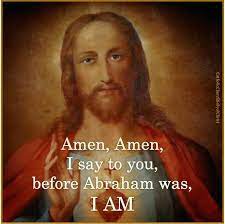
God alone IS
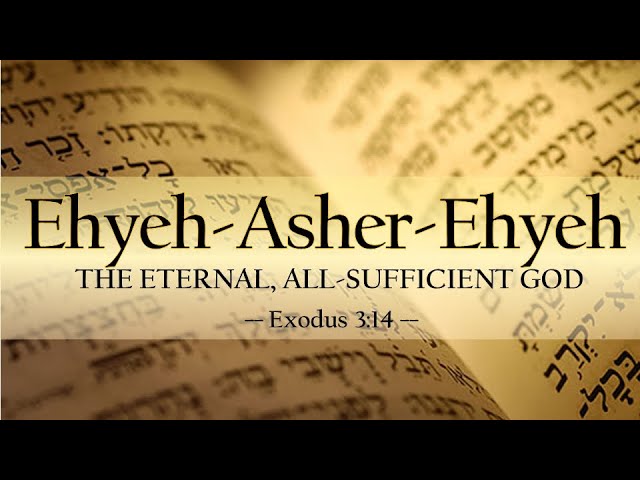
212 Over the centuries, Israel’s faith was able to manifest and deepen realization of the riches contained in the revelation of the divine name. God is unique; there are no other gods besides him.24 He transcends the world and history. He made heaven and earth: “They will perish, but you endure; they will all wear out like a garment. . . .but you are the same, and your years have no end.”25 In God “there is no variation or shadow due to change.”26 God is “HE WHO IS”, from everlasting to everlasting, and as such remains ever faithful to himself and to his promises.

213 The revelation of the ineffable name “I AM WHO AM” contains then the truth that God alone IS. The Greek Septuagint translation of the Hebrew Scriptures, and following it the Church’s Tradition, understood the divine name in this sense: God is the fullness of Being and of every perfection, without origin and without end. All creatures receive all that they are and have from him; but he alone is his very being, and he is of himself everything that he is.
24 Cf. Isa 44:6.
25 Ps 102:26-27.
26 Jas 1:17.
III. TRUE GOD AND TRUE MAN
464 The unique and altogether singular event of the Incarnation of the Son of God does not mean that Jesus Christ is part God and part man, nor does it imply that he is the result of a confused mixture of the divine and the human. He became truly man while remaining truly God. Jesus Christ is true God and true man.
During the first centuries, the Church had to defend and clarify this truth of faith against the heresies that falsified it.
465 The first heresies denied not so much Christ’s divinity as his true humanity (Gnostic Docetism). From apostolic times the Christian faith has insisted on the true incarnation of God’s Son “come in the flesh”.87 But already in the third century, the Church in a council at Antioch had to affirm against Paul of Samosata that Jesus Christ is Son of God by nature and not by adoption. The first ecumenical council of Nicaea in 325 confessed in its Creed that the Son of God is “begotten, not made, of the same substance (homoousios) as the Father”, and condemned Arius, who had affirmed that the Son of God “came to be from things that were not” and that he was “from another substance” than that of the Father.88
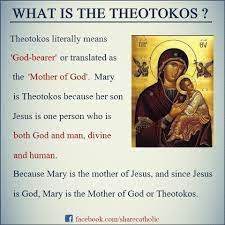
466 The Nestorian heresy regarded Christ as a human person joined to the divine person of God’s Son. Opposing this heresy, St. Cyril of Alexandria and the third ecumenical council, at Ephesus in 431, confessed “that the Word, uniting to himself in his person the flesh animated by a rational soul, became man.”89 Christ’s humanity has no other subject than the divine person of the Son of God, who assumed it and made it his own, from his conception. For this reason the Council of Ephesus proclaimed in 431 that Mary truly became the Mother of God by the human conception of the Son of God in her womb: “Mother of God, not that the nature of the Word or his divinity received the beginning of its existence from the holy Virgin, but that, since the holy body, animated by a rational soul, which the Word of God united to himself according to the hypostasis, was born from her, the Word is said to be born according to the flesh.”90
89 Council of Ephesus (431): DS 250.
90 Council of Ephesus: DS 251.
467 The Monophysites affirmed that the human nature had ceased to exist as such in Christ when the divine person of God’s Son assumed it. Faced with this heresy, the fourth ecumenical council, at Chalcedon in 451, confessed:Following the holy Fathers, we unanimously teach and confess one and the same Son, our Lord Jesus Christ: the same perfect in divinity and perfect in humanity, the same truly God and truly man, composed of rational soul and body; consubstantial with the Father as to his divinity and consubstantial with us as to his humanity; “like us in all things but sin”. He was begotten from the Father before all ages as to his divinity and in these last days, for us and for our salvation, was born as to his humanity of the virgin Mary, the Mother of God.91
91 Council of Chalcedon (451): DS 301; cf. Heb 4:15.
Mary’s divine motherhood
495 Called in the Gospels “the mother of Jesus”, Mary is acclaimed by Elizabeth, at the prompting of the Spirit and even before the birth of her son, as “the mother of my Lord”.144 In fact, the One whom she conceived as man by the Holy Spirit, who truly became her Son according to the flesh, was none other than the Father’s eternal Son, the second person of the Holy Trinity. Hence the Church confesses that Mary is truly “Mother of God” (Theotokos).145
144 Lk 1:43; Jn 2:1; 19:25; cf. Mt 13:55; et al.
145 Council of Ephesus (431): DS 251.
2677 Holy Mary, Mother of God: With Elizabeth we marvel, “And why is this granted me, that the mother of my Lord should come to me?”36 Because she gives us Jesus, her son, Mary is Mother of God and our mother; we can entrust all our cares and petitions to her: she prays for us as she prayed for herself: “Let it be to me according to your word.”37 By entrusting ourselves to her prayer, we abandon ourselves to the will of God together with her: “Thy will be done.”

Pray for us sinners, now and at the hour of our death: By asking Mary to pray for us, we acknowledge ourselves to be poor sinners and we address ourselves to the “Mother of Mercy,” the All-Holy One. We give ourselves over to her now, in the Today of our lives. And our trust broadens further, already at the present moment, to surrender “the hour of our death” wholly to her care. May she be there as she was at her son’s death on the cross. May she welcome us as our mother at the hour of our passing38 to lead us to her son, Jesus, in paradise.
36 Lk 1:43.
37 Lk 1:38.
38 Cf. Jn 19:27.
We confess that one and the same Christ, Lord, and only-begotten Son, is to be acknowledged in two natures without confusion, change, division or separation. The distinction between the natures was never abolished by their union, but rather the character proper to each of the two natures was preserved as they came together in one person (prosopon) and one hypostasis.92
92 Council of Chalcedon: DS 302
468 After the Council of Chalcedon, some made of Christ’s human nature a kind of personal subject. Against them, the fifth ecumenical council, at Constantinople in 553, confessed that “there is but one hypostasis [or person], which is our Lord Jesus Christ, one of the Trinity.”93 Thus everything in Christ’s human nature is to be attributed to his divine person as its proper subject, not only his miracles but also his sufferings and even his death: “He who was crucified in the flesh, our Lord Jesus Christ, is true God, Lord of glory, and one of the Holy Trinity.”94
469 The Church thus confesses that Jesus is inseparably true God and true man. He is truly the Son of God who, without ceasing to be God and Lord, became a man and our brother: “What he was, he remained and what he was not, he assumed”, sings the Roman Liturgy.95 And the liturgy of St. John Chrysostom proclaims and sings: “O only-begotten Son and Word of God, immortal being, you who deigned for our salvation to become incarnate of the holy Mother of God and ever-virgin Mary, you who without change became man and were crucified, O Christ our God, you who by your death have crushed death, you who are one of the Holy Trinity, glorified with the Father and the Holy Spirit, save us!”96
93 Council of Constantinople II (553): DS 424.
94 Council of Constantinople II (553): DS 432; cf. DS 424; Council of Ephesus, DS 255.
95 LH, 1 January, Antiphon for Morning Prayer; cf. St. Leo the Great, Sermo in nat. Dom. 1, 2; PL 54, 191-192.
96 Liturgy of St. John Chrysostom, Troparion “O monogenes.”
 Jesus Christ is New Paschal Lamb of God
You must be logged in to post a comment.