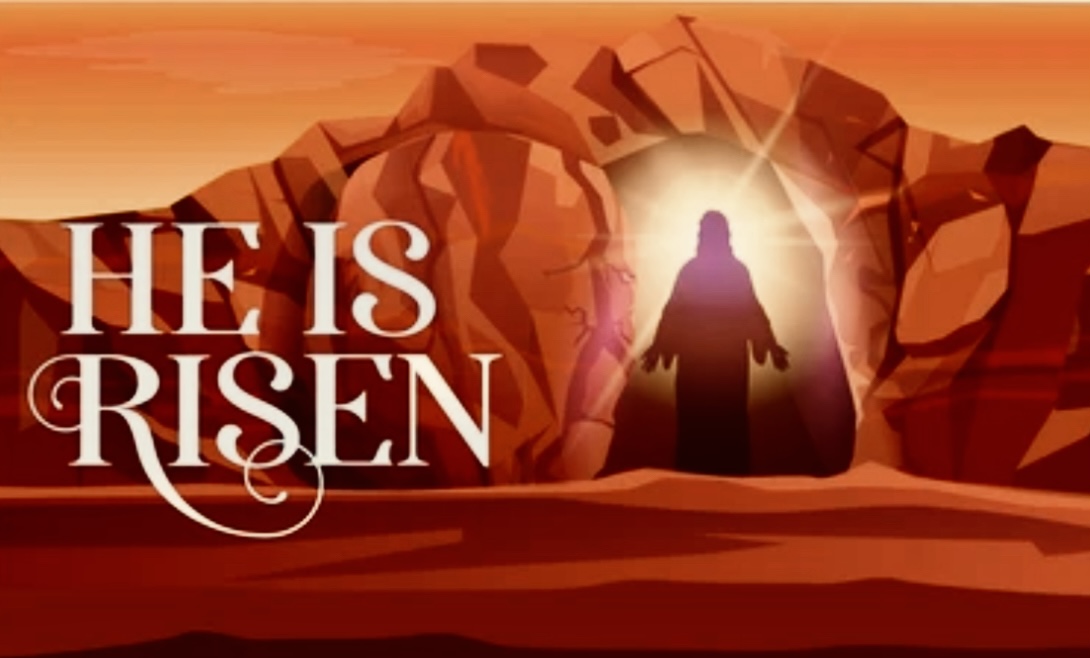
Jesus rose from the dead “on the first day of the week.”* Because it is the “first day,” the day of Christ’s Resurrection recalls the first creation. Because it is the “eighth day” following the sabbath,* it symbolizes the new creation ushered in by Christ’s Resurrection. For Christians it has become the first of all days, the first of all feasts, the Lord’s Day (he kuriake hemera, diesdominica)—Sunday:
We all gather on the day of the sun, for it is the first day [after the Jewish sabbath, but also the first day] when God, separating matter from darkness, made the world; and on this same day Jesus Christ our Savior rose from the dead.* – The Third Commandment, CCC 2174
*We all read Matthew 28:1, Mark 16:2, Luke 24:1, John 20:1
Matthew 28:1 NABRE
Chapter 28[a]
The Resurrection of Jesus. 1 After the sabbath, as the first day of the week was dawning,[b] Mary Magdalene and the other Mary came to see the tomb.
Footnotes
- 28:1–20 Except for Mt 28:1–8 based on Mk 16:1–8, the material of this final chapter is peculiar to Matthew. Even where he follows Mark, Matthew has altered his source so greatly that a very different impression is given from that of the Marcan account. The two points that are common to the resurrection testimony of all the gospels are that the tomb of Jesus had been found empty and that the risen Jesus had appeared to certain persons, or, in the original form of Mark, that such an appearance was promised as soon to take place (see Mk 16:7). On this central and all-important basis, Matthew has constructed an account that interprets the resurrection as the turning of the ages (Mt 28:2–4), shows the Jewish opposition to Jesus as continuing to the present in the claim that the resurrection is a deception perpetrated by the disciples who stole his body from the tomb (Mt 28:11–15), and marks a new stage in the mission of the disciples once limited to Israel (Mt 10:5–6); now they are to make disciples of all nations. In this work they will be strengthened by the presence of the exalted Son of Man, who will be with them until the kingdom comes in fullness at the end of the age (Mt 28:16–20).
- 28:1 After the sabbath…dawning: since the sabbath ended at sunset, this could mean in the early evening, for dawning can refer to the appearance of the evening star; cf. Lk 23:54. However, it is probable that Matthew means the morning dawn of the day after the sabbath, as in the similar though slightly different text of Mark, “when the sun had risen” (Mk 16:2). Mary Magdalene and the other Mary: see notes on Mt 27:55–56; 57–61. To see the tomb: cf. Mk 16:1–2 where the purpose of the women’s visit is to anoint Jesus’ body.
Mark 16:2New American Bible (Revised Edition)
2 Very early when the sun had risen, on the first day of the week, they came to the tomb.
Luke 24:1New American Bible (Revised Edition)
VIII. The Resurrection Narrative[a]
Chapter 24
The Resurrection of Jesus. 1 But at daybreak on the first day of the week they took the spices they had prepared and went to the tomb.
Footnotes
- 24:1–53 The resurrection narrative in Luke consists of five sections: (1) the women at the empty tomb (Lk 23:56b–24:12); (2) the appearance to the two disciples on the way to Emmaus (Lk 24:13–35); (3) the appearance to the disciples in Jerusalem (Lk 24:36–43); (4) Jesus’ final instructions (Lk 24:44–49); (5) the ascension (Lk 24:50–53). In Luke, all the resurrection appearances take place in and around Jerusalem; moreover, they are all recounted as having taken place on Easter Sunday. A consistent theme throughout the narrative is that the suffering, death, and resurrection of Jesus were accomplished in fulfillment of Old Testament promises and of Jewish hopes (Lk 24:19a, 21, 26–27, 44, 46). In his second volume, Acts, Luke will argue that Christianity is the fulfillment of the hopes of Pharisaic Judaism and its logical development (see Acts 24:10–21).
John 20:1New American Bible (Revised Edition)
Chapter 20[a]
The Empty Tomb.[b] 1 On the first day of the week,Mary of Magdala came to the tomb early in the morning, while it was still dark,[c] and saw the stone removed from the tomb.
Footnotes
20:1 Still dark: according to Mark the sun had risen, Matthew describes it as “dawning,” and Luke refers to early dawn. Mary sees the stone removed, not the empty tomb.
20:1–31 The risen Jesus reveals his glory and confers the Spirit. This story fulfills the basic need for testimony to the resurrection. What we have here is not a record but a series of single stories.
20:1–10 The story of the empty tomb is found in both the Matthean and the Lucan traditions; John’s version seems to be a fusion of the two.
 Jesus Christ is New Paschal Lamb of God
You must be logged in to post a comment.