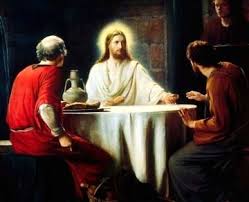
Who were two disciples?

Today is April 23th. We beloved Catholic brothers and sisters in Christ read daily readings through USCCB.

Wednesday in the Octave of Easter:

Please click on Who were two disciples?

St. Luke said that one of the disciples was Cleopas, but he doesn’t name the other. Interesting! Some says his wife??? No identity mentioned.

St. John’s Gospel says that Mary the wife of Clopas was among those standing by the cross when Jesus died.

We believe that “Clopas” and “Cleopas” were the same person. Furthermore, we believe that this person was also known as Alphaeus.

  • Clopas (or Cleopas): This name is used in the Gospel of Luke (Luke 24:13) and the Gospel of John (John 19:25) to refer to a man who traveled to Emmaus with another disciple after Jesus’ death. 
  • Alphaeus: This name is found in the New Testament (Matthew 10:3, Mark 3:18, Luke 6:15, Acts 1:13) and is used to identify the father of the apostle James the Less.
  • The Catholic and Eastern Orthodox traditions identify Clopas of Emmaus as the same person as Alphaeus, making him St. Joseph’s younger brother.

Both Catholic and Orthodox traditions believe that Clopas was the younger brother of St. Joseph, the husband of Mary and foster father of Jesus. Clopas, or Cleopas, was Mary’s brother-in-law. This would explain why “Mary the wife of Clopas” was standing by the cross. She was trying to comfort her sister-in-law

Gospel
Luke 24:13-35
❤️ 🤟🙏📿 That very day, the first day of the week,
two of Jesus’ disciples were going
to a village seven miles from Jerusalem called Emmaus,
and they were conversing about all the things that had occurred.
And it happened that while they were conversing and debating,
Jesus himself drew near and walked with them,
but their eyes were prevented from recognizing him.
He asked them,
“What are you discussing as you walk along?”
They stopped, looking downcast.
One of them, named Cleopas, said to him in reply,
“Are you the only visitor to Jerusalem
who does not know of the things
that have taken place there in these days?”
And he replied to them, “What sort of things?”
They said to him,
“The things that happened to Jesus the Nazarene,
who was a prophet mighty in deed and word
before God and all the people,
how our chief priests and rulers both handed him over
to a sentence of death and crucified him.
But we were hoping that he would be the one to redeem Israel;
and besides all this,
it is now the third day since this took place.
Some women from our group, however, have astounded us:
they were at the tomb early in the morning
and did not find his Body;
they came back and reported
that they had indeed seen a vision of angels
who announced that he was alive.
Then some of those with us went to the tomb
and found things just as the women had described,
but him they did not see.”
And he said to them, “Oh, how foolish you are!
How slow of heart to believe all that the prophets spoke!
Was it not necessary that the Christ should suffer these things
and enter into his glory?”
Then beginning with Moses and all the prophets,
he interpreted to them what referred to him
in all the Scriptures.
As they approached the village to which they were going,
he gave the impression that he was going on farther.
But they urged him, “Stay with us,
for it is nearly evening and the day is almost over.”
So he went in to stay with them.
And it happened that, while he was with them at table,
he took bread, said the blessing,
broke it, and gave it to them.
With that their eyes were opened and they recognized him,
but he vanished from their sight.
Then they said to each other,
“Were not our hearts burning within us
while he spoke to us on the way and opened the Scriptures to us?”
So they set out at once and returned to Jerusalem
where they found gathered together
the Eleven and those with them who were saying,
“The Lord has truly been raised and has appeared to Simon!”
Then the two recounted what had taken place on the way
and how he was made known to them in the breaking of the bread. ❤️🤟🙏📿
Jesus is risen early dawn on Sunday.

Jesus rose from the dead “on the first day of the week.”* Because it is the “first day,” the day of Christ’s Resurrection recalls the first creation. Because it is the “eighth day” following the sabbath,* it symbolizes the new creation ushered in by Christ’s Resurrection. For Christians it has become the first of all days, the first of all feasts, the Lord’s Day (he kuriake hemera, diesdominica)—Sunday:
We all gather on the day of the sun, for it is the first day [after the Jewish sabbath, but also the first day] when God, separating matter from darkness, made the world; and on this same day Jesus Christ our Savior rose from the dead.* – The Third Commandment, CCC 2174

Chapter 28[a]

The Resurrection of Jesus. After the sabbath, as the first day of the week was dawning,[b] Mary Magdalene and the other Mary came to see the tomb. 

Footnotes

  1. 28:1–20 Except for Mt 28:1–8 based on Mk 16:1–8, the material of this final chapter is peculiar to Matthew. Even where he follows Mark, Matthew has altered his source so greatly that a very different impression is given from that of the Marcan account. The two points that are common to the resurrection testimony of all the gospels are that the tomb of Jesus had been found empty and that the risen Jesus had appeared to certain persons, or, in the original form of Mark, that such an appearance was promised as soon to take place (see Mk 16:7). On this central and all-important basis, Matthew has constructed an account that interprets the resurrection as the turning of the ages (Mt 28:2–4), shows the Jewish opposition to Jesus as continuing to the present in the claim that the resurrection is a deception perpetrated by the disciples who stole his body from the tomb (Mt 28:11–15), and marks a new stage in the mission of the disciples once limited to Israel (Mt 10:5–6); now they are to make disciples of all nations. In this work they will be strengthened by the presence of the exalted Son of Man, who will be with them until the kingdom comes in fullness at the end of the age (Mt 28:16–20).
  2. 28:1 After the sabbath…dawning: since the sabbath ended at sunset, this could mean in the early evening, for dawning can refer to the appearance of the evening star; cf. Lk 23:54. However, it is probable that Matthew means the morning dawn of the day after the sabbath, as in the similar though slightly different text of Mark, “when the sun had risen” (Mk 16:2). Mary Magdalene and the other Mary: see notes on Mt 27:55–5657–61. To see the tomb: cf. Mk 16:1–2 where the purpose of the women’s visit is to anoint Jesus’ body.

Very early when the sun had risen, on the first day of the week, they came to the tomb. 

VIII. The Resurrection Narrative[a]

Chapter 24

The Resurrection of Jesus. But at daybreak on the first day of the week they took the spices they had prepared and went to the tomb.

Footnotes

  1. 24:1–53 The resurrection narrative in Luke consists of five sections: (1) the women at the empty tomb (Lk 23:56b–24:12); (2) the appearance to the two disciples on the way to Emmaus (Lk 24:13–35); (3) the appearance to the disciples in Jerusalem (Lk 24:36–43); (4) Jesus’ final instructions (Lk 24:44–49); (5) the ascension (Lk 24:50–53). In Luke, all the resurrection appearances take place in and around Jerusalem; moreover, they are all recounted as having taken place on Easter Sunday. A consistent theme throughout the narrative is that the suffering, death, and resurrection of Jesus were accomplished in fulfillment of Old Testament promises and of Jewish hopes (Lk 24:19a2126–274446). In his second volume, Acts, Luke will argue that Christianity is the fulfillment of the hopes of Pharisaic Judaism and its logical development (see Acts 24:10–21).

Chapter 20[a]

The Empty Tomb.[b] On the first day of the week,Mary of Magdala came to the tomb early in the morning, while it was still dark,[c] and saw the stone removed from the tomb.

Footnotes

20:1 Still dark: according to Mark the sun had risen, Matthew describes it as “dawning,” and Luke refers to early dawn. Mary sees the stone removed, not the empty tomb.

20:1–31 The risen Jesus reveals his glory and confers the Spirit. This story fulfills the basic need for testimony to the resurrection. What we have here is not a record but a series of single stories.

20:1–10 The story of the empty tomb is found in both the Matthean and the Lucan traditions; John’s version seems to be a fusion of the two.